Journal of Improvement Management

Journal of Improvement Management

Number of Volumes 16
Number of Issues 63
Number of Articles 416
Number of Contributors 898
Article View 558284
PDF Download 483,727
View Per Article 1342.03
PDF Download Per Article 1162.81
Number of Submissions 3,720
Acceptance Rate 6
Time to Accept (Days) 135
Number of Indexing Databases 17
Number of Reviewers 148

Journal of Improvement Management is an open-access, peer-reviewed quarterly journal dedicated to theoretical and empirical articles. Papers are subject to a double-blind peer review process to ensure the quality of their underlying research methodology and argument. This journal follows the Committee on Publication Ethics (COPE) and complies with the highest ethical standards by ethical laws.

The journal was established by Defence Industries Training and Research Institute. The submitted papers will be published after review and approval by the editorial board. Honorable professors and researchers would be highly appreciative if they visited this site, registered, submitted, and set up their papers based on the authors' guidelines. Therefore, visiting the journal in person or calling the journal office is not recommended, so all connections with authors and reviewers are made through the website. (Read More...)


Bibliographic Information


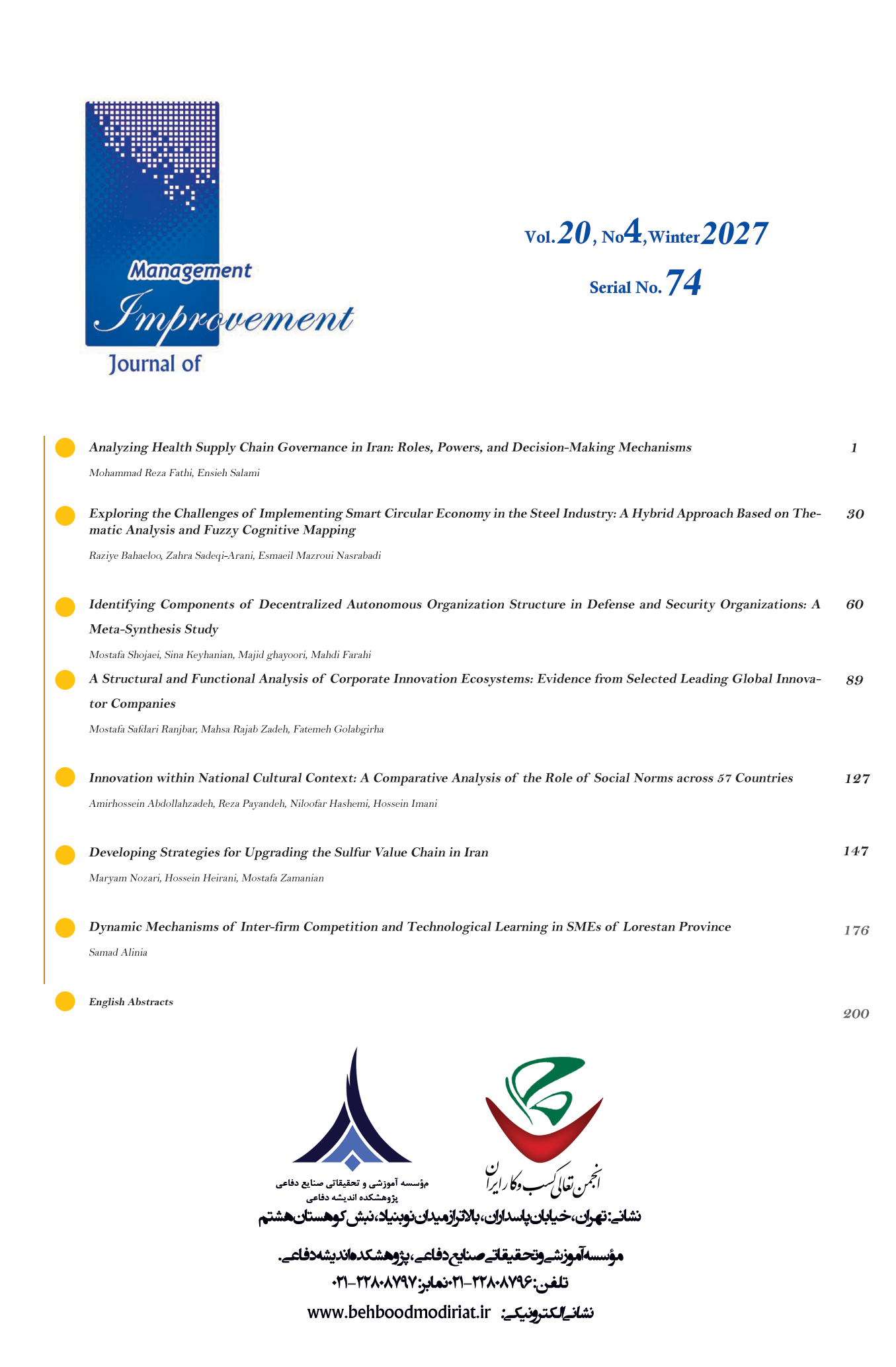
Current Issue: Volume 20, Issue 4 - Serial Number 74, Winter 2027 

Publication Information

Publisher

Director-in-Charge
Editor-in-Chief
Associate Editor

Frequency
Quarterly
Print ISSN
Online ISSN

Keywords Cloud

  • Industrial policy
  • Innovation
  • Grounded theory
  • Iran
  • Knowledge Management
  • Interpretive structural modeling
  • Thematic Analysis
  • automotive Industry
  • Open Innovation
  • Artificial intelligence
  • strategy
  • Defense Industries
  • Policy making
  • technology
  • Development
  • Innovation ecosystem
  • steel industry
  • Governance
  • Data Envelopment Analysis
  • Agility
  • Historical Analysis
  • Defense Industry
  • innovation policy
  • Technological Catch-Up
  • Value chain
  • game theory
  • industrial development
  • Challenges
  • Resilience
  • absorptive capacity
  • Science and technology policy
  • Technology Transfer
  • Outsourcing
  • Performance Evaluation
  • Institutional Analysis
  • Technology Development
  • Theme analysis
  • Blockchain
  • Supply chain
  • technological learning
  • structural equation modeling
  • banking industry
  • organizational performance
  • Technological collaboration
  • Confirmatory Factor Analysis
  • new product development
  • science and technology park
  • small and medium-sized enterprises (SMEs)
  • Oil Industry
  • Learning
  • COVID-19
  • content analysis
  • Scenario Planning
  • Supply chain management
  • flexibility
  • Energy Governance
  • Critical success factors
  • Competency
  • Innovation Capability
  • Petrochemical industry
  • Efficiency
  • organization
  • Innovation System
  • Importance-Performance Analysis (IPA)
  • Complex Products
  • Medical Equipment
  • Technological Capabilities
  • Policy
  • National Innovation System
  • Multi-level Perspective
  • performance
  • Strategies
  • Catch-up
  • Fuzzy Delphi
  • Network Governance
  • Discourse Analysis
  • Transformational Leadership
  • TOPSIS
  • Risk Management
  • Meta-Synthesis
  • Organizational Culture
  • effectiveness
  • complexity
  • Management
  • knowledge management strategy
  • Typology
  • Policy mix
  • Knowledge-Based Company
  • Startup
  • DEMATEL
  • Technology commercialization
  • Industrial cluster
  • Business strategy
  • Global Value Chain
  • collaboration
  • Pharmaceutical industry
  • Pilot Agency
  • VIKOR
  • Gap Analysis
  • Technology Acquisition
  • methodology
  • Austerity Economy
  • Competence
  • Strategic Agility
  • case study
  • Energy
  • Aviation industry
  • SWOT Analysis
  • Clustering
  • Delphi method
  • Quality Function Deployment
  • Knowledge Strategy
  • Networking
  • university
  • digital transformation
  • Q Method
  • Innovation Performance
  • SCENARIO ANALYSIS
  • Competitive advantage
  • Strategic Control
  • Banking System
  • public-private partnership
  • focus group
  • Strategic Planning
  • Environment
  • organizational commitment
  • Prioritization
  • Success Factors
  • Competition
  • Knowledge-based production
  • Influencing Factors
  • Fuzzy TOPSIS
  • Fuzzy cognitive map
  • Policymaking
  • Decision-making
  • Corporate Innovation Ecosystem
  • Financing
  • Dynamic Planning
  • Manufacturing Strategy
  • strategic management
  • challenge
  • Science and Technology Parks
  • Dynamic Capabilities
  • Yazd province
  • Supply Chain Resilience
  • Banking Contracts
  • industrial clusters
  • ethics
  • Innovation Strategy
  • risk
  • complex products and systems
  • Control
  • Nanotechnology
  • Political Economy
  • Food Industry
  • Strategic Alignment
  • Socio-technical transition
  • Political Networking
  • Policy Tools
  • Knowledge-Based Economy
  • Ambidexterity
  • Valley of Death
  • Science
  • Structural Capital
  • Commercialization
  • Pathology
  • Competitive Intelligence
  • Technological Innovation System
  • relational capital
  • Assessment
  • Emerging Technologies
  • MICMAC
  • Industrial Policymaking
  • Iranian industries
  • Policy learning
  • life cycle
  • Performance Management
  • Business Intelligence
  • human resources
  • Technology assessment
  • focus groups
  • Program Management Capabilities
  • Creative Economy
  • Multi-Objective Optimization
  • Economic Development
  • Biopharmaceutical
  • Individual factors
  • Importance-performance analysis
  • Industry 4
  • windows of opportunity
  • Energy Policy
  • research and development
  • Organizational Development
  • Business Model
  • Inverse GMCR
  • Industry
  • Megaprojects
  • structural analysis
  • Renewable Energy
  • product innovation