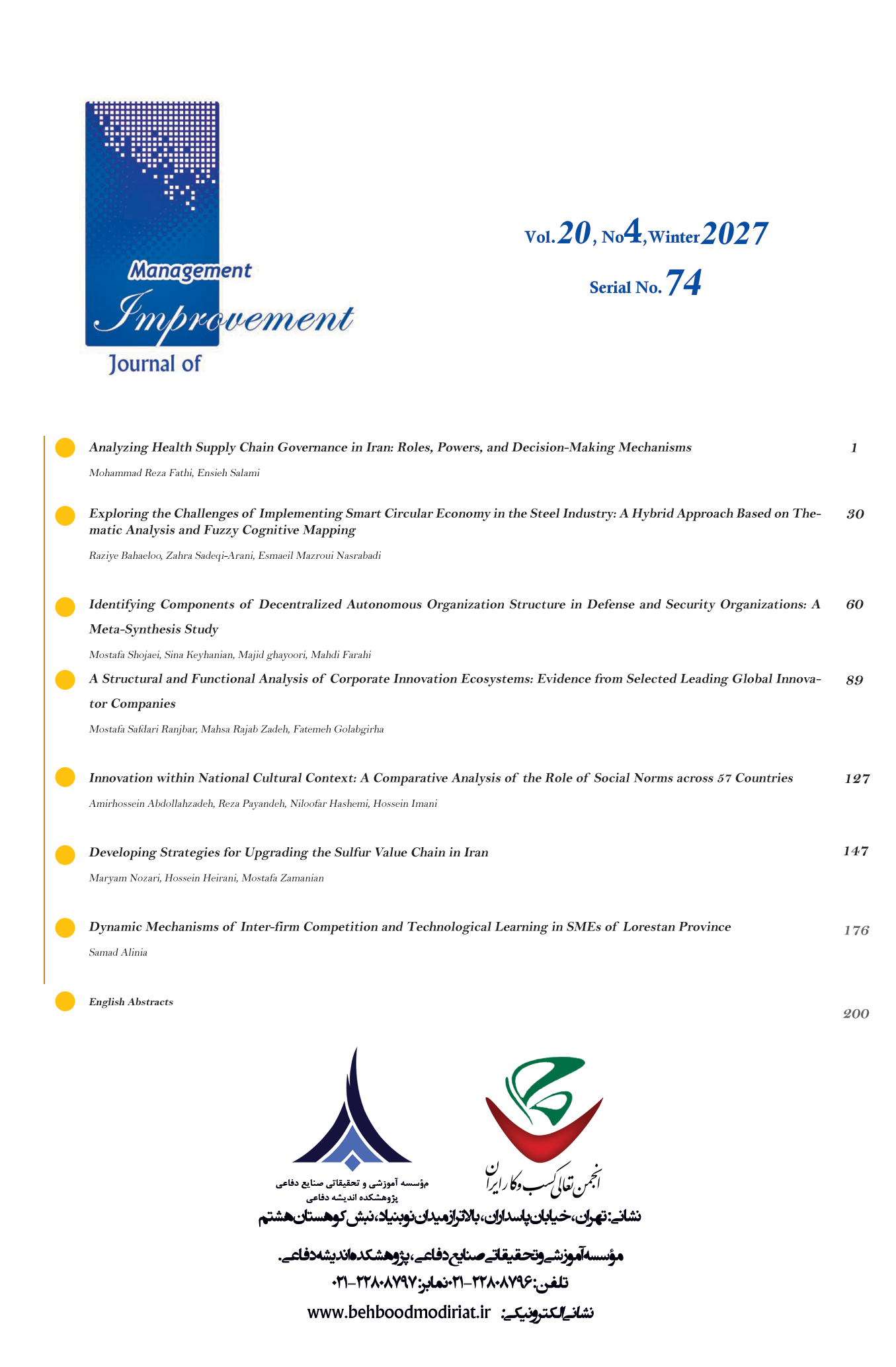
Journal of Improvement Management

Journal of Improvement Management

Number of Volumes 16
Number of Issues 63
Number of Articles 416
Number of Contributors 898
Article View 566053
PDF Download 489,442
View Per Article 1360.7
PDF Download Per Article 1176.54
Number of Submissions 3,724
Acceptance Rate 6
Time to Accept (Days) 135
Number of Indexing Databases 17
Number of Reviewers 148

Journal of Improvement Management is an open-access, peer-reviewed quarterly journal dedicated to theoretical and empirical articles. Papers are subject to a double-blind peer review process to ensure the quality of their underlying research methodology and argument. This journal follows the Committee on Publication Ethics (COPE) and complies with the highest ethical standards by ethical laws.

The journal was established by Defence Industries Training and Research Institute. The submitted papers will be published after review and approval by the editorial board. Honorable professors and researchers would be highly appreciative if they visited this site, registered, submitted, and set up their papers based on the authors' guidelines. Therefore, visiting the journal in person or calling the journal office is not recommended, so all connections with authors and reviewers are made through the website. (Read More...)


Bibliographic Information


Current Issue: Volume 20, Issue 4 - Serial Number 74, Winter 2027 

Publication Information

Publisher

Director-in-Charge
Editor-in-Chief
Associate Editor

Frequency
Quarterly
Print ISSN
Online ISSN

Keywords Cloud

  • Industrial policy
  • Innovation
  • Grounded theory
  • Iran
  • Knowledge Management
  • Interpretive structural modeling
  • automotive Industry
  • Thematic Analysis
  • strategy
  • Artificial intelligence
  • Open Innovation
  • Policy making
  • Defense Industries
  • steel industry
  • technology
  • Development
  • Innovation ecosystem
  • Governance
  • Agility
  • Data Envelopment Analysis
  • industrial development
  • Defense Industry
  • innovation policy
  • Technological Catch-Up
  • Value chain
  • game theory
  • Historical Analysis
  • Challenges
  • Resilience
  • absorptive capacity
  • structural equation modeling
  • Technology Transfer
  • organizational performance
  • Outsourcing
  • Performance Evaluation
  • Supply chain
  • Theme analysis
  • Blockchain
  • Technology Development
  • technological learning
  • Institutional Analysis
  • banking industry
  • Technological collaboration
  • Science and technology policy
  • Confirmatory Factor Analysis
  • new product development
  • Efficiency
  • Oil Industry
  • Learning
  • content analysis
  • Scenario Planning
  • COVID-19
  • science and technology park
  • small and medium-sized enterprises (SMEs)
  • flexibility
  • Critical success factors
  • Competency
  • Innovation Capability
  • Petrochemical industry
  • Supply chain management
  • organization
  • Fuzzy Delphi
  • Innovation System
  • Importance-Performance Analysis (IPA)
  • Complex Products
  • Medical Equipment
  • Technological Capabilities
  • Policy
  • National Innovation System
  • Multi-level Perspective
  • performance
  • Transformational Leadership
  • Strategies
  • Network Governance
  • Pharmaceutical industry
  • Organizational Culture
  • Catch-up
  • TOPSIS
  • Meta-Synthesis
  • Risk Management
  • Discourse Analysis
  • complexity
  • effectiveness
  • Management
  • knowledge management strategy
  • Typology
  • Policy mix
  • Knowledge-Based Company
  • Energy Governance
  • Startup
  • DEMATEL
  • Technology commercialization
  • Industrial cluster
  • Business strategy
  • Global Value Chain
  • collaboration
  • Pilot Agency
  • VIKOR
  • Gap Analysis
  • Technology Acquisition
  • methodology
  • Austerity Economy
  • Competence
  • Strategic Agility
  • case study
  • Energy
  • Aviation industry
  • Environment
  • university
  • SWOT Analysis
  • Delphi method
  • Quality Function Deployment
  • Networking
  • Clustering
  • Knowledge Strategy
  • Q Method
  • Innovation Performance
  • SCENARIO ANALYSIS
  • Competitive advantage
  • Strategic Control
  • Banking System
  • public-private partnership
  • focus group
  • Strategic Planning
  • digital transformation
  • organizational commitment
  • Prioritization
  • Success Factors
  • Competition
  • Knowledge-based production
  • Influencing Factors
  • Fuzzy TOPSIS
  • Fuzzy cognitive map
  • Policymaking
  • Decision-making
  • Dynamic Planning
  • Financing
  • Corporate Innovation Ecosystem
  • Manufacturing Strategy
  • strategic management
  • challenge
  • Science and Technology Parks
  • Dynamic Capabilities
  • Yazd province
  • Supply Chain Resilience
  • Banking Contracts
  • industrial clusters
  • ethics
  • Innovation Strategy
  • risk
  • complex products and systems
  • Control
  • Nanotechnology
  • Political Economy
  • Food Industry
  • Strategic Alignment
  • Socio-technical transition
  • Political Networking
  • Policy Tools
  • Knowledge-Based Economy
  • Ambidexterity
  • Valley of Death
  • Structural Capital
  • Science
  • Commercialization
  • Pathology
  • Competitive Intelligence
  • Emerging Technologies
  • relational capital
  • Assessment
  • Technological Innovation System
  • MICMAC
  • Industrial Policymaking
  • Iranian industries
  • Policy learning
  • life cycle
  • Performance Management
  • Business Intelligence
  • human resources
  • Technology assessment
  • focus groups
  • Program Management Capabilities
  • Creative Economy
  • Multi-Objective Optimization
  • Individual factors
  • Biopharmaceutical
  • Economic Development
  • Importance-performance analysis
  • Industry 4
  • windows of opportunity
  • Energy Policy
  • research and development
  • Organizational Development
  • Business Model
  • Industry
  • Renewable Energy
  • structural analysis
  • Megaprojects
  • product innovation
  • Inverse GMCR